Marin Eichler Buyers Guide
A complete due-diligence framework for buying an Eichler home in Marin County — covering all six tracts, SSO protections, Upper Lucas Valley zoning, radiant heat, roofs, glazing, and off-market access.
 Eichler VaultKevin Limprecht··10 min read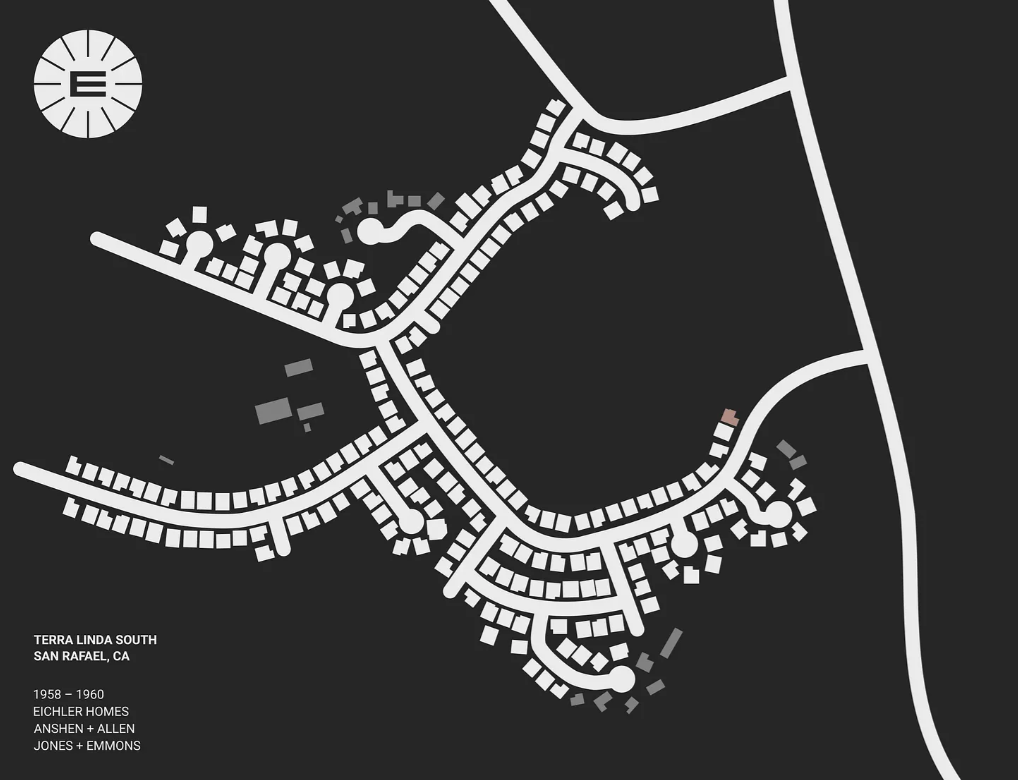
Marin County's Eichler inventory is unusually varied for a relatively concentrated architectural market. The principal Marin groupings include Terra Linda North and Terra Linda South in San Rafael, Marinwood and Lower Lucas Valley in unincorporated San Rafael, Upper Lucas Valley in unincorporated Marin County, Strawberry Point in Mill Valley, and Sleepy Hollow in San Anselmo. Together, these neighborhoods represent different periods of Eichler construction, different architectural assignments, different planning environments, and importantly for a buyer, different regulatory conditions.
Buying an Eichler in Marin therefore requires more than confirming that a house has an atrium, radiant heat, clerestory glazing, or an Eichler-era floor plan. The tract, parcel, jurisdiction, original plan, subsequent alterations, and applicable zoning controls can materially change what a buyer should investigate before closing. A house that appears similar architecturally to another Marin Eichler may have a very different regulatory history and a very different documentation trail.
Start With the Tract, Not the Listing
The first question for a Marin Eichler buyer should be deceptively simple: which tract is the house actually part of? Terra Linda North, Terra Linda South, Upper Lucas Valley, Marinwood/Lower Lucas Valley, Strawberry Point, and Sleepy Hollow should not be treated as interchangeable Eichler neighborhoods. Their development histories and regulatory frameworks differ, and those differences become particularly important when a buyer begins considering additions, roof work, glazing changes, interior alterations, electrical upgrades, or other modifications.
Terra Linda North and Terra Linda South are located within the City of San Rafael and are associated with the city's Eichler & Alliance Homes Combining District, commonly identified as the -EA district. The zoning framework is therefore part of the architectural due-diligence equation. Buyers should obtain the applicable current municipal regulations and verify how the specific parcel is regulated rather than relying solely on a listing description or neighborhood convention.
Upper Lucas Valley presents another regulatory environment. The neighborhood is in unincorporated Marin County and is associated with the R1 Lucas Valley residential zoning framework. The original Eichler development and its one-story architectural character make the distinction between ordinary residential zoning and specific development controls particularly important when evaluating future changes to a property.
Marinwood and Lower Lucas Valley require a different kind of diligence. The neighborhood has a strong and recognizable single-story Eichler character, but architectural character should not automatically be described as a formal single-story zoning overlay. Buyers considering vertical expansion or substantial exterior changes should verify the parcel's actual county zoning, applicable site controls, and any other restrictions affecting that particular property.
Strawberry Point and Sleepy Hollow likewise require parcel-specific research. Strawberry Point is in unincorporated Marin County, while Sleepy Hollow is within San Anselmo. The absence of a verified tract-wide single-story protection in the information available here should not be interpreted as permission for unrestricted alteration. Instead, the buyer should determine the governing zoning, height standards, design-review requirements, easements, CC&Rs where applicable, and any other restrictions before assuming what can or cannot be changed.
Terra Linda Height Restrictions Matter
Height is one of the easiest Eichler zoning issues to misunderstand because a height limit and a one-story restriction are not necessarily the same legal instrument. For Terra Linda North and Terra Linda South, the San Rafael -EA framework identifies a maximum height of approximately 17 feet to the peak and restricts the development to one habitable floor under the cited framework. The practical consequence for a buyer is that an apparently straightforward second-story or vertical-expansion idea should never be evaluated solely from the roofline.
Upper Lucas Valley has a different framework. The material used for this buyer guide identifies a 15-foot-6-inch maximum for the Eichler-design context under Marin County's R1 zoning, with one-story development and strong restrictions on vertical expansion. Because zoning provisions can change and individual parcels can carry additional controls, buyers should confirm the current county code and parcel-specific requirements before relying on any stated dimensional limit.
That distinction is important when purchasing an Eichler as a long-term architectural project. A buyer may be able to remodel kitchens, bathrooms, mechanical systems, glazing, or finishes without fundamentally changing the house's exterior volume, while a proposed addition or roof alteration can trigger a completely different level of zoning and design review.
Marinwood and Lower Lucas Valley: Character Is Not the Same as an Overlay
Marinwood and Lower Lucas Valley deserve particular attention because their architectural consistency can create the impression that a formal single-story ordinance automatically governs every house. The available framework instead identifies the area as relying on underlying county zoning and parcel-specific controls, with a strong single-story neighborhood character rather than a verified municipal single-story overlay.
For a buyer, that distinction is more than terminology. If future expansion is part of the purchase strategy, the relevant question is not simply whether neighboring houses are one story. The buyer should determine the property's actual zoning designation, applicable development standards, setbacks, height limits, design-review requirements, and any recorded restrictions before treating the surrounding architectural pattern as a legal limitation.
This is also where an Eichler buyer's architectural research can become genuinely useful. Understanding why a neighborhood looks the way it does helps explain the physical environment, but the legal question must still be answered through the governing jurisdiction and the specific parcel.
The Roof Is a System, Not Just a Surface
Low-slope Eichler roofs deserve a dedicated inspection because their geometry and drainage characteristics differ substantially from conventional pitched residential roofs. Buyers should establish the original roof profile where possible, document subsequent reroofing, identify the current roof assembly, understand drainage direction, and inspect flashings, perimeter terminations, penetrations, vents, skylights, and other roof openings.
Spray polyurethane foam, commonly called SPF, appears in the renovation history of many low-slope Eichler roofs and should be documented rather than treated as a generic roof material. The buyer should determine when the SPF was installed, whether it has been recoated, what coating system was used, whether repairs have occurred, and what documentation remains from the installer. A roof with a documented maintenance history is a very different due-diligence proposition from one where the buyer has no reliable record of installation or subsequent work.
The objective is not simply to decide whether the roof is "good" or "bad." The objective is to establish what system is present, how old it is, how water is intended to move across the roof, where penetrations occur, and what records exist. For an Eichler, roof geometry is part of the original architectural system, so roof investigation should be connected to both building science and architectural documentation.
Radiant Heat Requires Its Own Investigation
Unlisted Eichler Alerts & Early Intent Intelligence
Off-Market Seller Signals. Quiet Listings. Unlisted Archive Records.
A significant portion of pristine Eichler properties trade through private transfers or whisper networks before reaching the public MLS. Secure early access to off-market seller signals, quiet listing updates, and unlisted archive records across California's premier Eichler tracts before they go public.
Original Eichler radiant heating is another system that should be investigated independently from a conventional HVAC inspection. A buyer should establish the pipe material, boiler configuration, manifold condition, water pressure, circuit arrangement, repair history, and any known history of leaks or abandoned circuits.
The presence of radiant heat does not by itself establish that the system is original or that it remains fully operational. Conversely, the presence of replacement components does not necessarily mean the architectural heating system has been abandoned. The important question is what remains in the slab, what equipment currently serves it, what repairs have occurred, and whether the system's operating history has been documented.
Because radiant tubing is embedded in the slab, problems can become substantially more complicated than replacing an exposed mechanical component. Buyers should therefore collect whatever records are available before closing, including prior service documentation, boiler replacement information, pressure observations, manifold photographs, and any known repair locations.
Windows, Atriums, and Glazing Are Architectural Evidence
Eichler glazing should be evaluated as both a building system and an architectural record. Original window frames, atrium glass, sliding doors, clerestory glazing, glass walls, and later replacement units can reveal how substantially a house has changed since construction.
A buyer should document which openings remain original, which have been replaced, and whether replacement assemblies preserve the dimensions and visual relationships of the original design. The same principle applies to atrium configurations and major glass-wall alterations. In an Eichler, glazing is not merely a collection of windows; it is one of the principal elements through which the original relationship between interior space, courtyard, landscape, and daylight was designed.
Electrical and Slab History Belong in the Same Due-Diligence File
Electrical documentation should include the original service where identifiable, panel history, branch-circuit upgrades, solar installations, EV charging equipment, and any other significant electrical modifications. Older Eichler neighborhoods can contain multiple generations of electrical work, making the panel visible today only one part of the property's electrical history.
The slab should receive similar attention. Buyers should document slab type where known, visible cracking, previous repairs, drainage conditions, alterations, penetrations, and any available history involving radiant heating. The objective is not to diagnose structural conditions from a buyer checklist; it is to establish a documentary record and identify issues that require evaluation by appropriately qualified professionals.
Architectural Provenance Can Change How You Understand the House
An Eichler buyer should also establish the house's model and plan record whenever documentation is available. The tract, construction period, floor-plan series, architect assignment, original plan number, atrium configuration, clerestory arrangement, beam structure, fireplace, and other defining elements can help establish whether the house still substantially reflects its original design.
This is particularly useful in Marin because the neighborhoods represent different phases of Eichler development and different architectural relationships. Claude Oakland's work, for example, is part of the architectural story of Marin's later Eichlers, while earlier developments connect to the broader Eichler design program and its associated architectural firms. The objective is not to assign a generic label to every house, but to determine the specific architectural record of the property being purchased.
Buying an Off-Market Marin Eichler
For buyers interested in an off-market Eichler, the same technical discipline applies. An unlisted house should not be treated as a shortcut around due diligence; it is simply a different way of discovering an opportunity. A direct introduction can provide an earlier opportunity to understand the house's architectural history, renovation record, mechanical systems, and owner's documentation before the property enters a conventional marketing process.
This can be particularly relevant in Marin, where the inventory is divided among several distinct Eichler environments and individual houses can have unusually specific architectural histories. Buyers who understand the tract, model series, radiant heating, roof construction, glazing, slab, electrical system, and zoning framework can ask substantially more useful questions when a house becomes available.
The Marin Eichler Buyer Standard
The Marin Eichler buyer's objective should be documentation before assumption. Establish the tract, identify the jurisdiction, verify the zoning, document the roof, investigate radiant heating, record glazing changes, understand electrical history, examine slab and drainage conditions, and reconstruct the model and architectural record before making conclusions about the property.
Most importantly, do not confuse architectural character with legal protection. Terra Linda's -EA framework, Upper Lucas Valley's R1 environment, and the parcel-specific conditions affecting Marinwood/Lower Lucas Valley, Strawberry Point, and Sleepy Hollow demonstrate why a Marin Eichler needs to be evaluated on its actual regulatory and architectural record.
This is the foundation of Eichler buyer due diligence: not simply asking whether a house looks like an Eichler, but determining what the house is, where it came from, what remains original, what has been changed, which systems serve it today, and what the governing rules allow the next owner to do.
Kevin Limprecht | Real Broker LLC | CA DRE #02233783 | [email protected]
Written by
Kevin Limprecht
Founder, Eichler Vault
[email protected] · California DRE 02233783 · Real Broker, LLC
