The 6 Eichler Neighborhoods That Define Marin County
Marin County Eichlers: A Provenance Guide to Terra Linda, Lucas Valley, Strawberry Point and Sleepy Hollow
 Eichler VaultKevin Limprecht··5 min read
Marin County Eichlers: A Provenance Guide to Terra Linda, Lucas Valley, Strawberry Point and Sleepy Hollow
Marin County’s Eichler history is often reduced to a single number: more than 1,700 homes. That figure is useful, but it obscures the architectural story. From the first Terra Linda houses of the mid-1950s to Claude Oakland’s final Marin work in Sleepy Hollow, Eichler developed a sequence of neighborhoods that document changing ideas about privacy, daylight, landscape, construction and California modernism. At The Eichler Vault, I am interested in that deeper record—where a house came from, who designed it, what model it represents, and which elements of its original architecture remain.
Terra Linda North established the Marin Eichler experiment.
Developed beginning in 1955, Terra Linda North contains approximately 630 Eichler homes and represents Eichler’s first major Marin subdivision. Anshen & Allen and Jones & Emmons shaped much of its architectural language, producing houses organized around atriums, courtyards, clerestories, radiant-heated floors and post-and-beam structures. Streets around Freitas Parkway, Las Ovejas Avenue and the smaller residential courts reveal an important characteristic of Eichler development: these were never simply repeated houses. Plan variations, including two-story examples, create a more complicated architectural record than the generic “Eichler” label suggests.
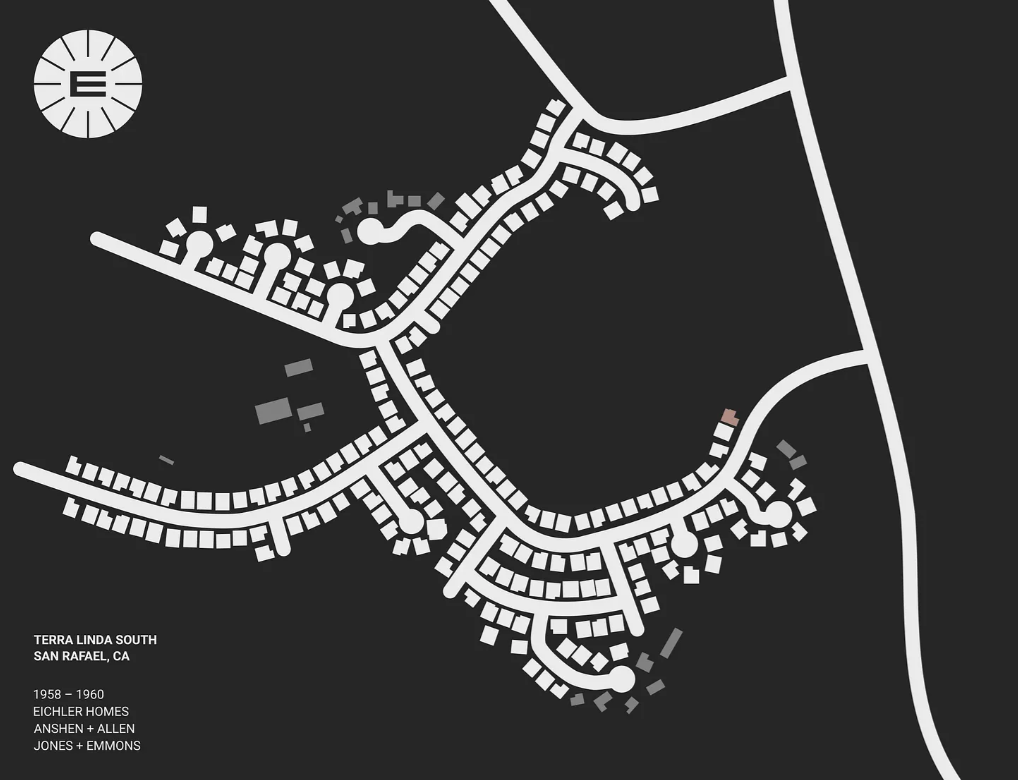
Terra Linda South belongs in the record as its own tract.
Approximately 220 Eichler homes were constructed between 1958 and 1960, extending the Terra Linda experiment into a later phase. Around Golden Hinde Boulevard and Nova Albion Way, the relationship between house, courtyard and surrounding landscape reflects a more mature version of Eichler’s planning philosophy. For provenance purposes, separating Terra Linda North from Terra Linda South matters because construction date, architect, model lineage and original site planning can distinguish houses that otherwise appear remarkably similar.
Marinwood and Lower Lucas Valley reveal Eichler as a neighborhood planner.
Approximately 375 Eichler homes were developed in 1957 and 1958 in the area commonly associated with Marinwood, Lower Lucas Valley and “The Berries,” with streets including Appleberry, Cedarberry, Juniperberry and Kernberry. The architecture contains familiar Eichler signatures—clerestory light, radiant heat, redwood interiors, private outdoor rooms and carefully controlled indoor-outdoor connections—but the larger significance is the relationship between individual houses and the neighborhood. Original setbacks, landscaping, street patterns and open space are part of the architectural provenance.
Upper Lucas Valley requires more careful documentation.
Unlisted Eichler Alerts & Early Intent Intelligence
Off-Market Seller Signals. Quiet Listings. Unlisted Archive Records.
A significant portion of pristine Eichler properties trade through private transfers or whisper networks before reaching the public MLS. Secure early access to off-market seller signals, quiet listing updates, and unlisted archive records across California's premier Eichler tracts before they go public.
The Lucas Valley community contains roughly 538 homes, but that figure should not be mistaken for the number of Eichlers because American Housing Guild houses are also present. Historical estimates place the Eichler component in the several-hundred-home range. Beyond Lucas Valley Road, the oak-covered landscape, buried utilities and larger lots create a setting distinctly different from Terra Linda. Here Eichler’s architecture becomes increasingly integrated with the terrain rather than simply arranged across a conventional subdivision.
Strawberry Point preserves one of Eichler’s most unusual late experiments.
Only 13 Eichler houses were completed at Harbor Point in 1965, although the original development envisioned approximately 99 homes. The surviving houses near Strawberry Point and the Mill Valley waterfront therefore carry significance beyond their individual architecture. They represent a failed larger vision for a premium Eichler community and preserve a rare example of the company attempting to bring its residential philosophy into a substantially more exclusive waterfront setting.
Sleepy Hollow documents the final Marin chapter.
Fifteen Claude Oakland-designed Eichlers were constructed in the early 1970s in the Sleepy Hollow area near Butterfield Road and the creekside landscape north of San Anselmo. Their larger footprints and later-period massing make them materially different from the compact Terra Linda houses of the 1950s. They are important precisely because they demonstrate how dramatically the Eichler program had evolved by the end of its development history.
For me, the significance of Marin’s Eichlers comes down to provenance. The same principle applies when studying an original Tribeca loft, a historic penthouse or a converted industrial building: architectural value cannot be established from photographs or a “mid-century modern” description alone. The meaningful record includes the architect, construction date, original plan, tract history, materials, alterations and relationship to the surrounding neighborhood.
That distinction becomes increasingly important as Marin Eichlers are renovated and repurposed. The rare house is not necessarily the largest or most extensively restored. It may be the one retaining an unusual plan, original atrium relationship, intact redwood interiors, distinctive clerestory configuration or an unusually complete connection between architecture and landscape.
The Eichler Vault documents these distinctions because Marin County’s Eichlers are not interchangeable examples of postwar housing. Terra Linda North, Terra Linda South, Marinwood, Lucas Valley, Strawberry Point and Sleepy Hollow represent different moments in Eichler’s architectural history. Once their provenance is reconstructed, the houses become more than mid-century homes—they become surviving evidence of how California modernism was actually built, lived in and subsequently repurposed.
Kevin Limprecht | Founder, Eichler Vault | Cell: 650-788-9621 | [email protected]
Written by
Kevin Limprecht
Founder, Eichler Vault
[email protected] · California DRE 02233783 · Real Broker, LLC