Sequoyah Hills: Oakland's Hillside Eichler Neighborhood and Its Architectural Record
Developed by Eichler Homes between 1964 and 1966, Sequoyah Hills occupies a distinctive position in the Eichler story — a hillside setting, a concentrated record of late-period plans, and an unusually strong preservation framework that sets it apart from the company's earlier suburban tracts.
 Eichler VaultKevin Limprecht··4 min read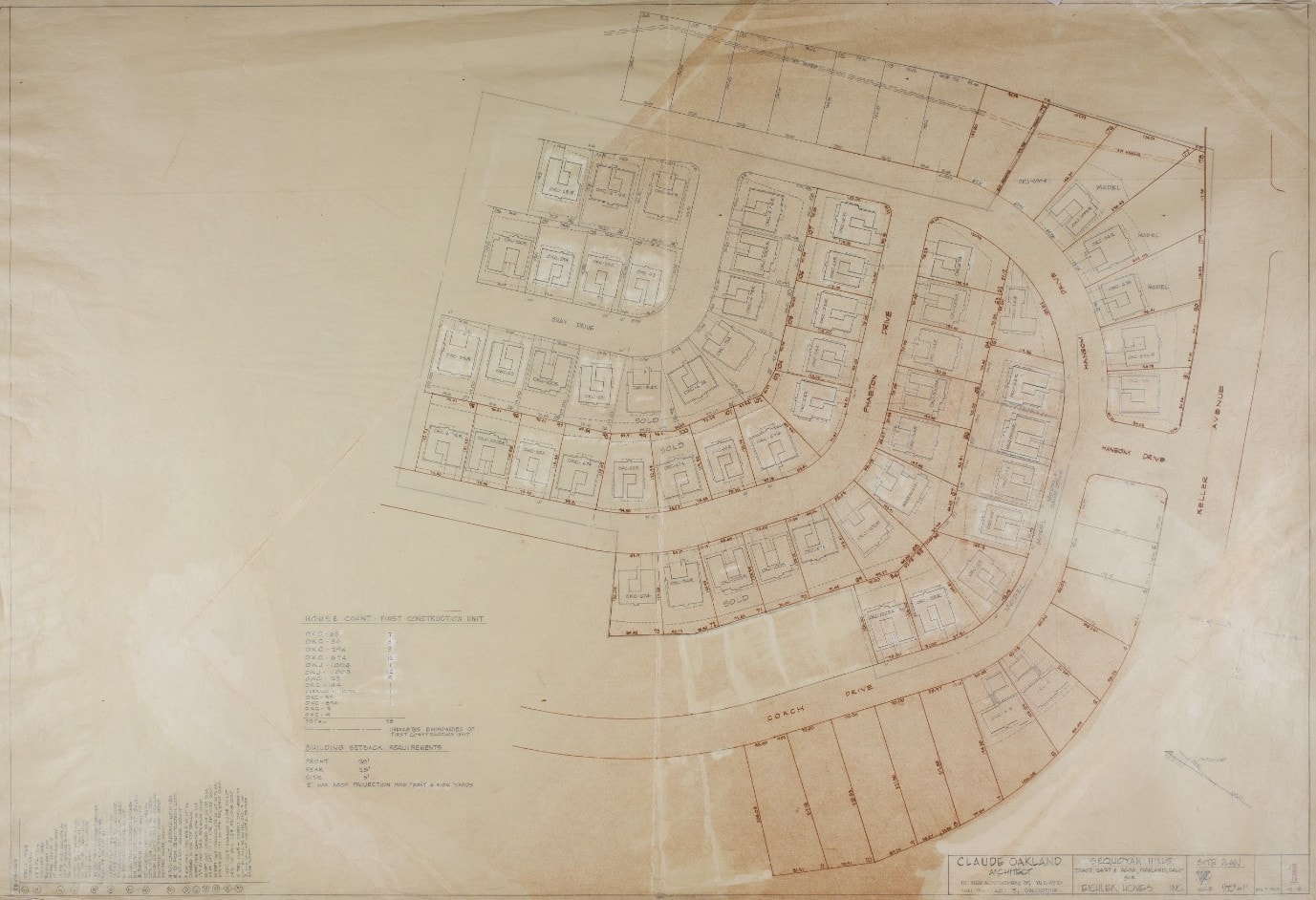
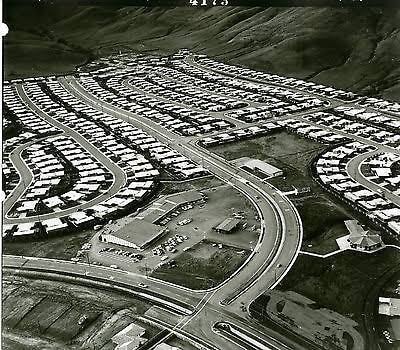
Above Interstate 580 in the Oakland hills, Sequoyah Hills occupies a distinctive position in the Eichler story. Developed by Eichler Homes between 1964 and 1966, the community comprises approximately 53 to 54 Eichler residences clustered around Keller Avenue, with homes extending along Coach Drive, Hanson Drive, Phaeton Drive, and Shay Drive.
A Later Period of Eichler Development
Sequoyah Hills belongs to a later period of Eichler development, when the company was building in increasingly varied terrain and working with a broader architectural vocabulary. The neighborhood reflects that evolution in both its hillside setting and its collection of plans, bringing together work associated with Claude Oakland & Associates as well as Jones & Emmons.
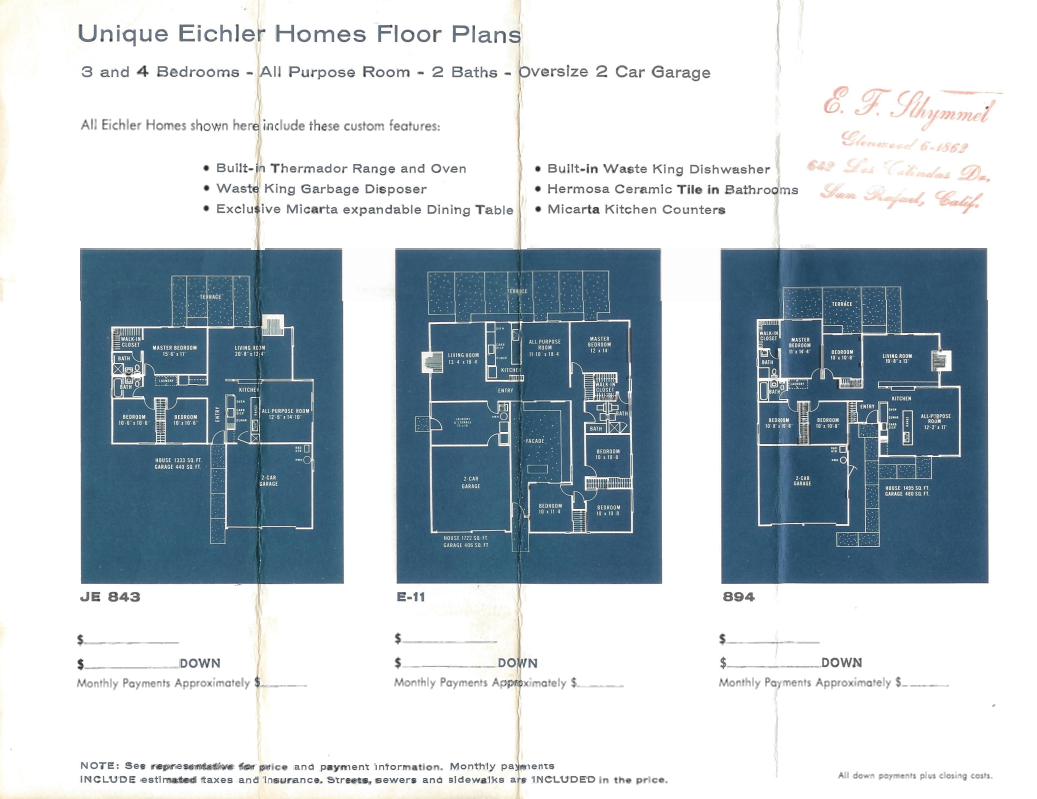
The surviving homes represent a substantial range of documented designs. Known plans include OKC-63, OKC-34, OKC-294, OKC-674, OKJ-1004, OKJ-1005, OKC-25, OKC-144, the Marraccini House, OKC-35, OKC-894, OKC-3, and OKC-4. That concentration of identified plans makes Sequoyah Hills particularly useful for understanding how Eichler's later Oakland developments adapted established planning concepts to a more topographically complex site.
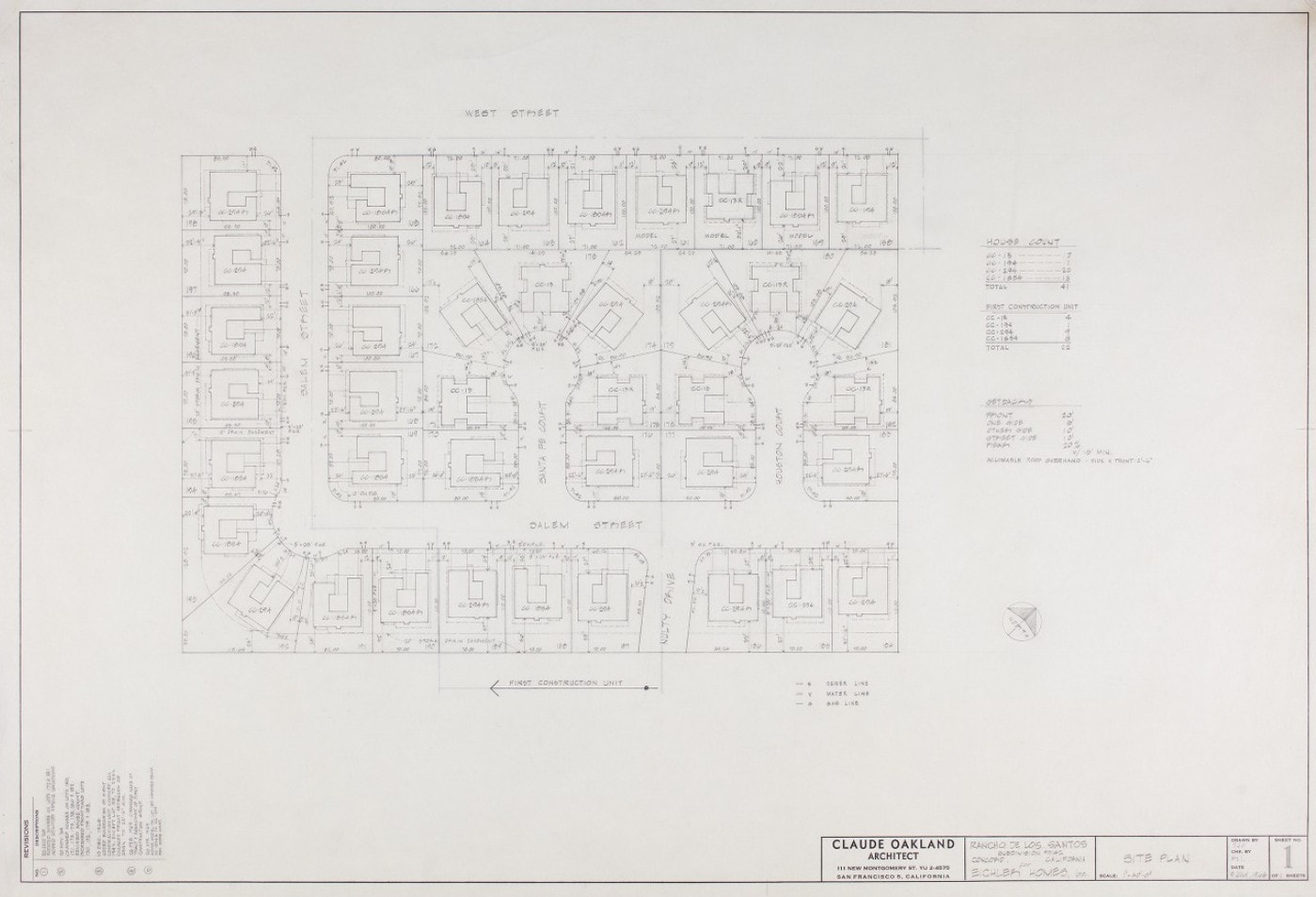
The original Claude Oakland site plan — reproduced above — documents the neighborhood's first construction unit. The curved geometry of Coach Drive and Phaeton Drive is visible in the plan, along with individual lot assignments, model designations, and building setback requirements. The plan is stamped by Claude Oakland, Architect, and identifies the developer as Eichler Homes, Inc.
The Atrium and Gallery Vocabulary
The architecture is notable for its use of the atrium and gallery vocabulary. Unlike some Eichler neighborhoods where the atrium concept appears only selectively, Sequoyah Hills includes homes incorporating these characteristic interior-to-exterior transitions — allowing the relationship between enclosed living space, landscape, and daylight to remain central to the plan.
This is consistent with Claude Oakland's approach during the mid-1960s, when the atrium had become a defining element of Eichler's Oakland-area work. The Sequoyah Hills record provides a useful cross-section of how that vocabulary was applied across a range of lot configurations and orientations on a hillside site.
Hillside Setting as Architectural Character
The neighborhood's hillside location is part of its architectural character rather than simply a geographic descriptor. Streets rise above Keller Avenue, and the Eichlers are concentrated within a relatively defined portion of the larger residential landscape. The resulting relationship between house, grade, street, and surrounding vegetation gives Sequoyah Hills a different spatial quality from Eichler communities built across flatter suburban tracts.
Unlisted Eichler Alerts & Early Intent Intelligence
Off-Market Seller Signals. Quiet Listings. Unlisted Archive Records.
A significant portion of pristine Eichler properties trade through private transfers or whisper networks before reaching the public MLS. Secure early access to off-market seller signals, quiet listing updates, and unlisted archive records across California's premier Eichler tracts before they go public.
That spatial quality is visible in the site plan. The curved street geometry of Coach Drive and Phaeton Drive was not simply a planning convention — it was a response to the topography, and it shaped the orientation and setback of every home in the neighborhood.
Preservation Recognition
Sequoyah Hills has an important preservation dimension. Oakland's Cultural Heritage Survey has identified the area as a potential historic district and determined that the Eichler residences contribute to that architectural context. While the neighborhood is not listed as an official historic district, the homeowners association provides an additional layer of architectural oversight and preservation control.
That combination of documented architectural significance and private community governance makes Sequoyah Hills an unusually interesting Eichler neighborhood. The houses are not simply surviving examples of postwar development — collectively, they form a concentrated record of Eichler's later work in Oakland and the ways the company's architects responded to a hillside setting.
The Vault Record
For the Eichler Vault, the value of Sequoyah Hills lies in the relationship between the individual house and the larger tract record. Original neighborhood plans, architectural drawings, known model assignments, and homeowner documentation can clarify the history of a property in ways that a contemporary listing record cannot. As additional documentation is identified and individual homes are better understood, the record of Sequoyah Hills becomes more complete.
The Sequoyah Hills tract page documents the neighborhood's known plans, street layout, and architectural context. Homeowners with original drawings, permit records, or plan documentation are encouraged to contribute through the Community Archivist intake on that page.
Oakland's East Bay Eichler Context
Sequoyah Hills is one of several East Bay Eichler neighborhoods documented in the Vault's California Tract Registry. For those researching the broader Oakland and East Bay record, the Greenridge tract in Castro Valley — known formally as Greenridge View Homes — represents another late-period East Bay development with its own distinct plan history and setting.
Sequoyah Hills remains one of Oakland's more distinctive concentrations of Eichler architecture, with its later construction date, varied plan history, hillside setting, and unusually strong preservation framework. Its approximately 53 to 54 surviving homes provide a compact architectural record of a period when Eichler Homes was extending the language of modern California housing into more demanding sites and increasingly individualized residential environments.
Written by
Kevin Limprecht
Founder, Eichler Vault
[email protected] · California DRE 02233783 · Real Broker, LLC