Sunnyvale Eichler Homes: Model Numbers, Double A-Frames, and the Off-Market Record
Six Sunnyvale Eichler neighborhoods — Fairbrae, Parmer Place, Fairorchard, Rancho Sans Souci, Midtown, and Rancho Verde — and why model-level documentation matters when researching the surviving inventory.
 Eichler VaultKevin Limprecht··5 min read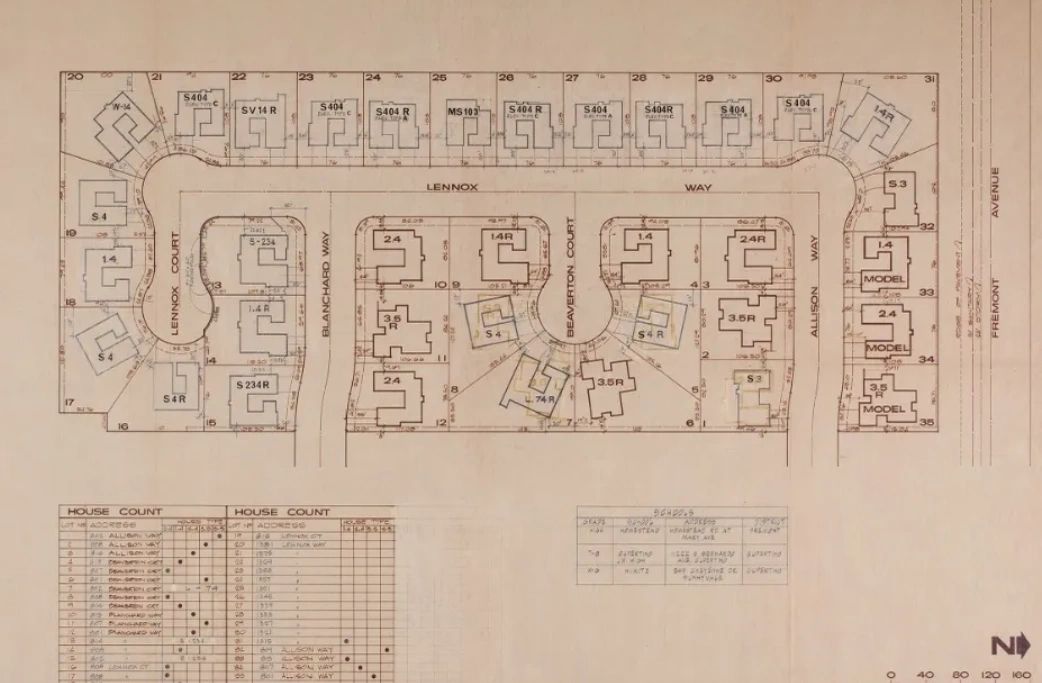
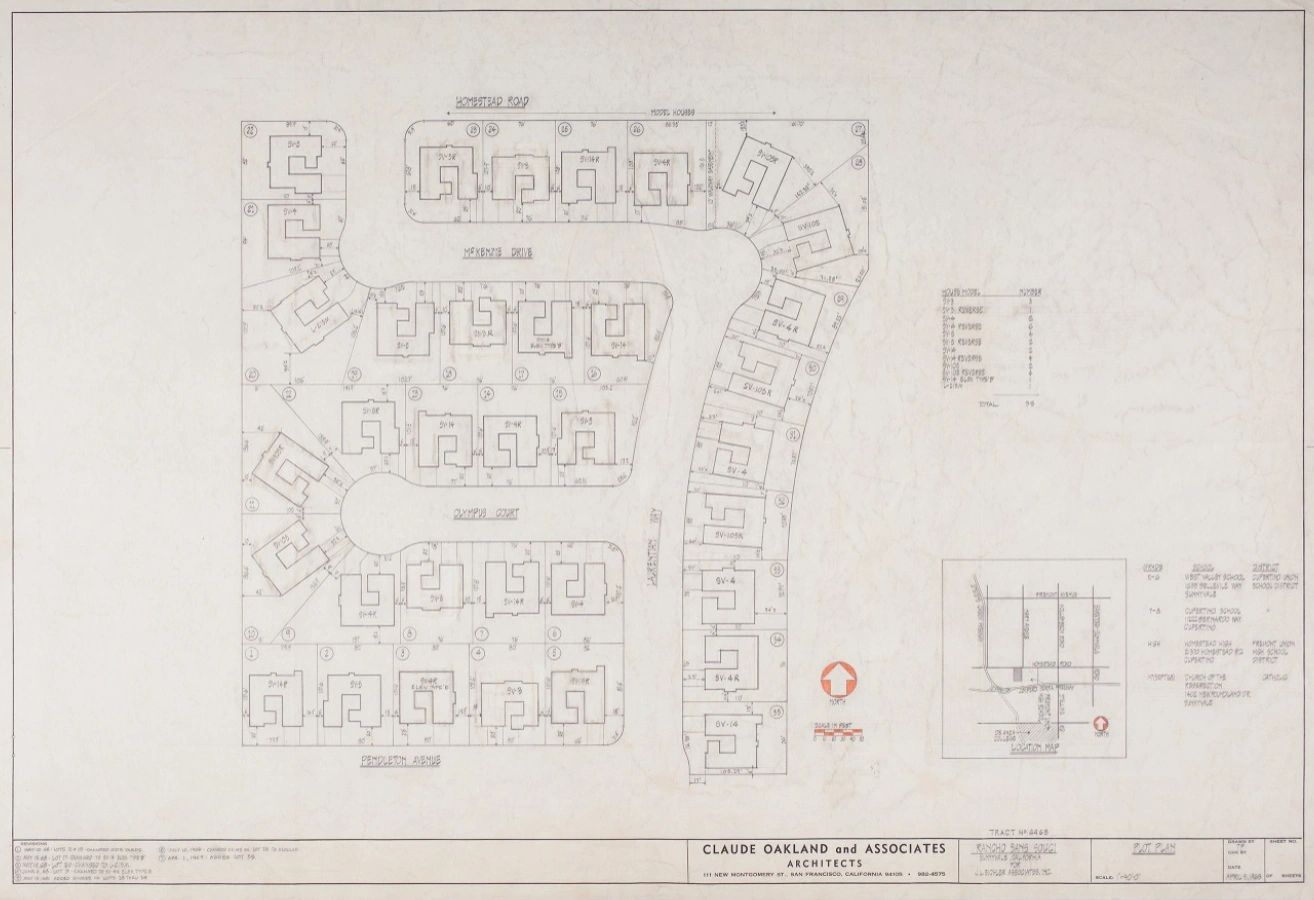
The Eichler record becomes considerably more interesting once you move beyond the tract name and start looking at the individual plans. Across California, surviving Eichler homes can be distinguished by original model numbers, plan revisions, roof structures, atrium configurations, gallery layouts, and other architectural details that are often invisible in a conventional real estate listing. Six Sunnyvale neighborhoods — Fairbrae, Parmer Place, Fairorchard, Rancho Sans Souci, Midtown, and Rancho Verde — illustrate why model-level documentation matters when researching the surviving Eichler inventory.
Why Model Numbers Matter
For researchers, the model number is effectively part of the Eichler cipher. In these Sunnyvale neighborhoods, the record includes an unusually broad sequence of plans and revisions, including O-4, O-4R, O-103, O-103R, O-104, O-104R, O-105, O-105R, O-114, O-114R, O-115, O-115R, O-123, O-123R, O-124, O-124R, O-134, O-134R, O-144, and O-144R, alongside SV-94, SV-94R, and SV-1544. Those designations are not interchangeable. The R variants and differences between related model numbers are part of the historical record, helping researchers identify how Eichler's plans evolved and how a particular surviving house relates to the original architectural program.
That distinction becomes especially useful when looking at double A-frame Eichlers. The roof structure is one of the quickest ways to recognize that a house may belong to a particular family of plans, but the roof alone does not tell the entire story. The relationship between the double A-frame, atrium, interior gallery, bedroom wing, living spaces, and garage configuration can help connect what exists today to an original model designation. A house that appears broadly similar to another Eichler from the street can therefore represent a different plan, revision, or architectural configuration once the original drawings are compared.
Gallery Models and What the MLS Misses
The same is true of gallery models. Gallery configurations can be easy to overlook in a conventional property search because MLS photography tends to emphasize finishes, renovations, kitchens, and staging rather than the underlying geometry of the original Eichler plan. For the Vault, the original floor plan is often more revealing. It can establish the relationship between the major rooms, the atrium or courtyard, circulation paths, roof structure, and later modifications in a way that a contemporary listing cannot.
This is one reason Eichlers can trade off market without leaving a complete public architectural record behind. Some owners have held their houses for decades. Others find buyers through personal relationships, neighborhood networks, architectural communities, or direct introductions. When a transaction occurs without a conventional MLS campaign, the market may record the transfer while losing important information about the house itself — particularly if the property is subsequently remodeled.
The Six Sunnyvale Tracts
The Eichler Vault approaches that problem from the architectural side. Members of the Vault community contribute original floor plans, tract plans, photographs, historical material, and other documentation that can help identify and verify individual homes. Those contributions are then useful for comparing model numbers, recognizing variations, tracking unusual configurations, and understanding how the surviving inventory relates to the original Eichler development record.
The Eichler Vault community portal extends that process across California. Homeowners and researchers can contribute material and download rare original floor plans and tract documentation covering Eichler neighborhoods from Marin County and San Marin to the South Bay, East Bay, Peninsula, and Thousand Oaks. The result is a living architectural record that can be updated when an original drawing surfaces, a homeowner identifies a previously undocumented variation, or an individual house provides new evidence about a particular model family.
Unlisted Eichler Alerts & Early Intent Intelligence
Off-Market Seller Signals. Quiet Listings. Unlisted Archive Records.
A significant portion of pristine Eichler properties trade through private transfers or whisper networks before reaching the public MLS. Secure early access to off-market seller signals, quiet listing updates, and unlisted archive records across California's premier Eichler tracts before they go public.
That matters because the surviving Eichler inventory is not a collection of interchangeable mid-century houses. The difference between an O-103 and O-103R, an O-114 and O-114R, or an O-134 and O-134R can be meaningful to someone researching the original architecture. The same is true of the O-123, O-123R, O-124, O-124R, O-144, and O-144R families, as well as the SV-94, SV-94R, and SV-1544 plans. These identifiers provide a framework for understanding what was actually built rather than relying solely on the contemporary appearance of a remodeled house.
Tract Pages
Each of the six Sunnyvale neighborhoods has a dedicated tract record in the Eichler Vault registry:
- Fairbrae — one of Sunnyvale's largest Eichler developments, with a broad plan inventory and documented double A-frame configurations
- Parmer Place — a compact micro-tract with a tightly documented plan sequence
- Fairorchard — Anshen & Allen designs with a distinctive courtyard and gallery record
- Rancho Sans Souci — a well-preserved neighborhood with original plan documentation
- Midtown — Sunnyvale's central Eichler cluster, with multiple plan families represented
- Rancho Verde — a later-phase Sunnyvale development with Claude Oakland plan attribution
Provenance Before the Next Sale
For homeowners, that record can also become important when an Eichler changes hands. A rare plan or intact double A-frame configuration may be difficult to identify from a standard property search, particularly when the house has been substantially renovated or has never been publicly marketed. Documenting the original architecture before that information disappears gives the next owner, researcher, or preservationist a much stronger starting point.
The six neighborhoods of Fairbrae, Parmer Place, Fairorchard, Rancho Sans Souci, Midtown, and Rancho Verde are therefore useful not simply as geographic locations, but as part of a much larger architectural dataset. Their model numbers, double A-frame structures, gallery configurations, original plans, and individual-home histories help explain the complexity of California's remaining Eichler inventory — and why some of its most interesting information exists beyond the MLS.
Explore the full Eichler Vault archive to research California Eichler neighborhoods, contribute original documentation, and access rare floor plans and tract records.
Eichler Vault is an independent architectural data registry and media network. Information is provided for informational, educational, and research purposes and should be independently verified.
Kevin Limprecht — Founder, Eichler Vault · California DRE License 02233783
Written by
Kevin Limprecht
Founder, Eichler Vault
[email protected] · California DRE 02233783 · Real Broker, LLC